Middle East Crisis
We have now suspended updates on this page, but continue to monitor the situation and remain available to support both passenger and cargo charter requests to and from the region.
For charter enquiries, please contact us.
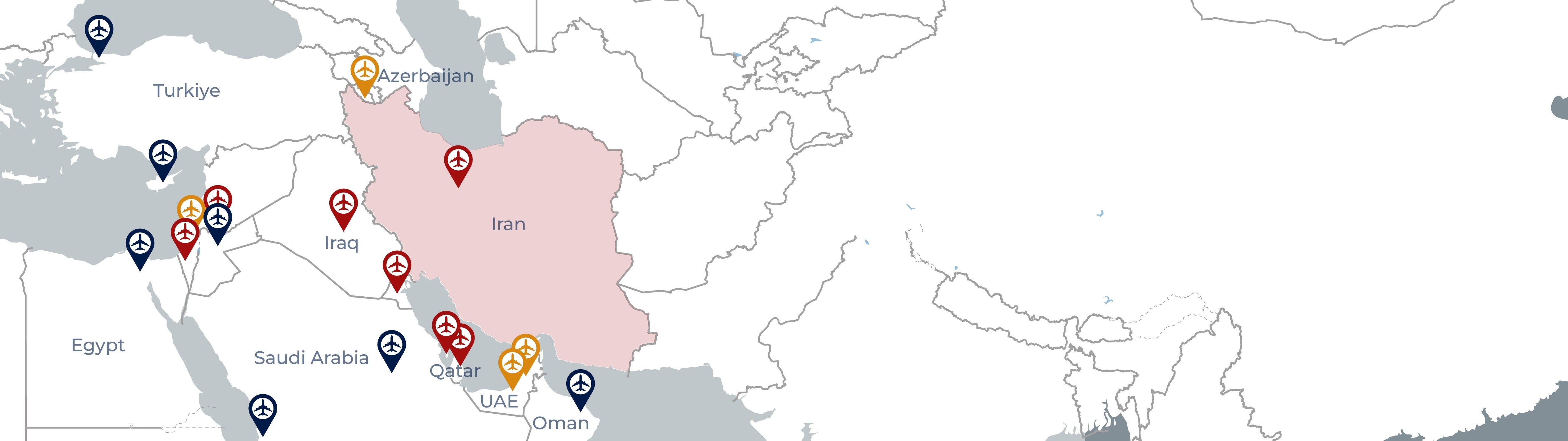
We have now suspended updates on this page, but continue to monitor the situation and remain available to support both passenger and cargo charter requests to and from the region.
For charter enquiries, please contact us.
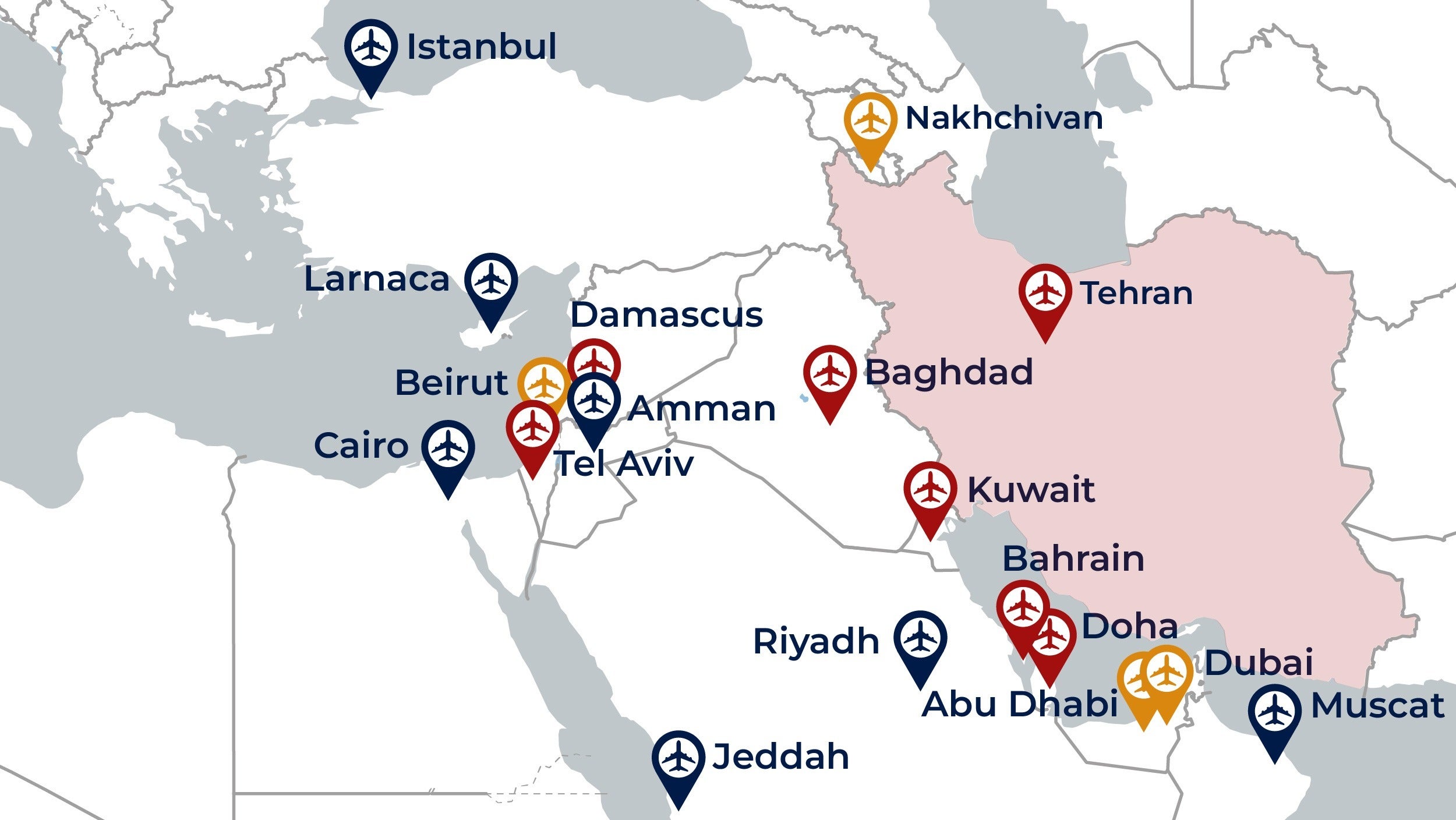
ACS has been coordinating multiple evacuation and emergency response flights across the Middle East for commercial, private, and governmental clients. Our teams are actively monitoring regional airspace closures, NOTAMs, and airport operational restrictions to ensure rapid, compliant routing as the situation evolves.
Despite the airspace closures there are options to move cargo into the surrounding region and we are exploring overland transport to cover the last miles to destination (or first miles from origin).
Please find the latest regional airspace updates and aircraft availability outlined below along with border crossing information. This information is reviewed continuously and updated as new information becomes available, but please check with your ACS account manager for the latest information as the situation is evolving rapidly.
CONTACT USBelow is an overview of regional airspaces and their current status.
| Country: | Airspace Status: | Additional Info: | Updated |
|---|---|---|---|
| United Arab Emirates | Open | The UAE is currently on heightened alert amid reports of missile and drone activity in the wider region. Authorities remain vigilant and response teams are prepared to manage any potential developments. UAE airspace remains open, with flights operating through designated waypoint corridors. However, aircraft may be re-routed at short notice depending on security and air traffic control requirements. The partial opening of UAE airspace has allowed local operators to offer availability from Dubai and Abu Dhabi. Some carriers have moved operations to Fujairah, Al Maktoum, Sharjah, and Ras Al Khaimah as "safe zone" alternatives. | 23 March 26 09:30 UTC |
| Saudi Arabia | Open | Saudi Arabia remains on high military alert following continued interceptions of drones. Airspace remains open, but is now under Increased Risk following explosions near Aramco facilities in Riyadh on 19 March. Major airports in Riyadh, Jeddah, and Dhahran are operational for commercial flights, though passengers are urged to confirm status due to recent diversions following reported incidents near the US embassy Short notice airspace restrictions or closures are possible if similar attacks persist. GPS jamming has been reported beginning near Riyadh. Riyadh is currently prioritising military and diverted traffic; expect 8+ hour delays.GPS jamming has expanded from Riyadh to the Eastern Province. Saudi airspace is currently the only major North-South corridor open in the region, leading to extreme congestion and rerouting of almost all Europe-Asia traffic. | 23 March 26 09:30 UTC |
| Egypt | Open | Normal operations continue as a primary southern bypass for international traffic. Military readiness remains high. | 23 March 26 09:30 UTC |
| Israel | Closed | While the airspace is technically closed, Ben Gurion Airport is partially open under severe limitations. As of today, outbound flights are restricted to one per hour with a cap of 50 passengers per aircraft. El Al is currently reviewing all remaining operations due to sustained missile fire. |
23 March 26 09:30 UTC |
| Oman | Open | Muscat remains open and is the primary regional hub for relief and evacuation flights for the entire Middle East. It is currently at 160% capacity and authorities are advising a minimum 6-hour check-in for all repatriation flights due to the surge in land-to-air transit from the UAE. Oman has placed its military on high alert due to ongoing strikes in the South and on shipping. GPS interference is now affecting 60% of arrivals in the southern corridor. | 23 March 26 09:30 UTC |
| Kuwait | Closed | National airspace remains closed following recent attacks. While limited repatriation and military cargo flights utilise restricted contingency corridors, all scheduled services are suspended indefinitely.A new drone attack reportedly hit a radar system at Kuwait International and the airport remains shut until further notice. Kuwaiti citizens are currently being repatriated via Jeddah, with the final leg of the journey completed by land. | 23 March 26 09:30 UTC |
| Qatar | Closed | Airspace is closed following direct attacks on gas facilities on 19 March. Current arrivals and departures at Hamad International require PPR and are limited primarily to repatriation/cargo. | 23 March 26 09:30 UTC |
| Jordan | Open | Airspace is open but remains on maximum military alert. Jordan has now removed the nightly airspace restrictions. Queen Alia International continues to serve as a technical stop for diverted flights, though several regional carriers have suspended regular service to Amman through late March. | 23 March 26 09:30 UTC |
| Lebanon | Open | Operating a skeletal daylight-only schedule. Major strikes hit South Lebanon and Beirut districts on 17-18 March, leading most international carriers to maintain suspensions. The Port of Beirut and sea routes to Cyprus are the primary exit gateways for foreign nationals. | 23 March 26 09:30 UTC |
| Bahrain | Closed | Airspace remains strictly closed to civilian traffic. | 23 March 26 09:30 UTC |
| Iraq | Closed | All civilian operations at Baghdad, Erbil, and Basra are suspended following strikes targetting U.S. bases and the U.S. embassy. While Baghdad, Erbil, and Basra airports have suspended all scheduled operations, limited military-coordinated evacuations are occurring under strict security protocols. The Turkey border at Ibrahim Khalil remains the only open land exit. Iran and Kuwait borders are closed. | 23 March 26 09:30 UTC |
| Syria | Closed | Syrian airspace remains strictly closed to commercial traffic. Land borders are considered dangerous due to regional strikes. | 23 March 26 09:30 UTC |
| Turkiye | Open | Airspace is fully operational but subject to flow management due to rerouted traffic. Turkish authorities have implemented a 72-hour transit visa waiver for passengers stranded due to the closures in Iran and Iraq to ease airport overcrowding. | 23 March 26 09:30 UTC |
| Iran | Closed | Airspace is closed with very limited exceptions. Major hubs remain under threat of airstrikes. | 23 March 26 09:30 UTC |
| Cyprus | Open | Cyprus remains on high security alert following a second attempted drone strike on the RAF Akrotiri base area last weekend. While Larnaca and Paphos airports are fully operational, they are facing extreme congestion as the island serves as the primary European evacuation bridge for thousands of nationals arriving from Lebanon and Israel. Larnaca Port continues to be the critical maritime hub for sea-to-air transfers, with authorities coordinating round-the-clock ferry arrivals from Beirut. | 23 March 26 09:30 UTC |
| Yemen | Restricted | Airspace remains highly restricted due to ongoing military strikes on launch sites in Sana’a and Hodeidah. Land borders with Saudi Arabia and Oman have emerged as the only restricted exit routes for those able to reach them, though travel remains highly dangerous due to ongoing airstrikes and internal conflict. | 23 March 26 09:30 UTC |
| Azerbaijan | Open | Azerbaijan has maintained its "combat alert" status for southern civilian flight corridors following recent drone incursions along the Iranian border. While the north remains a vital 100km-wide transit corridor for Europe-Asia traffic, this closure has caused significant congestion. Land borders with Iran reopened for essential cargo on 9 March, but remain closed for routine civilian traffic. | 23 March 26 09:30 UTC |
Information current as of 23 March 26 09:30 UTC
Below is an overview of regional land border crossings and their current status.
| Border Crossing | Crossing location | Current Status | Intel Reported | Visa Information |
|---|---|---|---|---|
| UAE - Saudi Arabia |
Al Ghuwaifat - Al Batha |
Closed | Confirmed closed to all civilian traffic as of 06:00 on 20 March. Saudi forces have extended the "Security Exclusion Zone" to 40km. Even Saudi nationals are being diverted to sea routes. |
Visitors generally need a pre-approved eVisa (available to citizens of over 60 countries and certain visa/residency holders), and mandatory medical insurance, which can be obtained through the official Saudi eVisa Portal. No Visa on Arrival at land border. |
| UAE - Oman | Al Ain - Al Buraimi | Closed | As of 04:00 on 23 March, Oman has closed all land borders to the UAE. The "Restricted" status for e-visa holders is void; authorities are now strictly enforcing a "Return to Origin" policy for all civilians. Specific crossing points: Meyzad (Hafeet): Open; used for all nationalities. Khatm Al Shikla: Reported as open for both GCC and non-GCC passport holders. Al Rawdah: Also operational to help relieve pressure on other points. |
Citizens of over 100 countries can enter visa-free for up to 14 days all others or those staying longer must apply for an eVisa through the official Royal Oman Police Portal. |
| UAE - Oman | Hatta - Al Wajajah | Closed | As of 04:00 on 23 March, Oman has closed all land borders to the UAE. The "Restricted" status for e-visa holders is void; authorities are now strictly enforcing a "Return to Origin" policy for all civilians. Oman has suspended the issuance of arrival visas at the border. Only those with pre-approved e-visas or Omani residency may cross. |
Citizens of over 100 countries can enter visa-free for up to 14 days all others or those staying longer must apply for an eVisa through the official Royal Oman Police Portal. |
| UAE - Oman | Khatmat Malaha (Kalba, Sharjah) | Closed | As of 04:00 on 23 March, Oman has closed all land borders to the UAE. The "Restricted" status for e-visa holders is void; authorities are now strictly enforcing a "Return to Origin" policy for all civilians. Oman has suspended the issuance of arrival visas at the border. Only those with pre-approved e-visas or Omani residency may cross. |
Citizens of over 100 countries can enter visa-free for up to 14 days all others or those staying longer must apply for an eVisa through the official Royal Oman Police Portal. |
| Bahrain - Saudi Arabia | GCC Crossing / King Fahd Causeway | Closed | Saudi Arabia has officially suspended all civilian transit on the Causeway as of 08:00 on 23 March. The 12-hour backlog has been ordered to disperse back into Manama. |
Visitors generally need a pre-approved eVisa (available to citizens of over 60 countries and certain visa/residency holders), and mandatory medical insurance, which can be obtained through the official Saudi eVisa Portal. No Visa on Arrival at land border. |
| Qatar - Saudi Arabia | Abu Samra - Salwa | Closed | Following the 19 March Ras Laffan attacks, Saudi authorities have physically barricaded the Salwa crossing to prevent a mass exodus, citing "national security concerns. New reports indicate Saudi Arabia has deployed "Electronic Jamming" units at the border, disrupting all GPS-based logistics and civilian navigation apps within 15km of Salwa. |
Visitors generally need a pre-approved eVisa (available to citizens of over 60 countries and certain visa/residency holders), and mandatory medical insurance, which can be obtained through the official Saudi eVisa Portal. |
| Israel - Jordan | King Hussein (Allenby) Bridge | Closed | The closure is now extended indefinitely following a military standoff 5km east of the crossing. | All visitors must obtain a pre-approved visa or Jordan Pass (for eligible nationalities) prior to arrival at the bridge. No Visa on Arrival at land border. |
| Israel - Jordan | Jordan River (Sheikh Hussein) - Northern Crossing | Restricted | Diplomatic waiver required for foreign nationals. Open to Israeli passport holders and tourists. Crossing is operating on a skeletal schedule with a 15:00 a cut-off. |
Visa on Arrival available for non-restricted nationalities and Jordan Pass is accepted for eligible nationalities |
| Israel - Jordan | Yitzhak Rabin (Wadi Araba) - Southern Crossing | Closed | The "Diplomatic Waiver" system was suspended on 23 March. The Eilat side is now a designated military staging area. |
Visa on Arrival available for non-restricted nationalities and Jordan Pass is accepted for eligible nationalities. |
| Israel - Egypt | Taba Border Crossing | Closed | The "Emergency Closure" remains. Egyptian authorities have started evacuating the Taba border terminal to secure inland facilities; no new arrivals are being processed. |
Most nationalities can get a Sinai-Only Visa (15 days) at the border. For travel beyond Sinai, a full Tourist Visa must be pre-approved via the Egypt eVisa Portal. |
| Israel - Egypt | Rafah crossing | Closed | No civilian movement is currently permitted. | N/A |
| Israel - Egypt | Kerem Shalom (Karem Abu Salem) | Restricted | Currently designated strictly for humanitarian aid and commercial goods only. Closed to civilians | Entry/exit for international aid workers requires pre-coordinated military permits and COGAT authorisation. |
| Kuwait - Saudi Arabia | Al-Nuwaiseeb - Al-Khafji |
Closed | This crossing remains closed. New reports indicate Saudi Arabia has established a 10km "No-Man's Land" on the Ar-Ruqi side, with no timeline for reopening. |
Visitors generally need a pre-approved eVisa (available to citizens of over 60 countries and certain visa/residency holders), and mandatory medical insurance, which can be obtained through the official Saudi eVisa Portal. |
| Kuwait - Saudi Arabia | Al-Salmi - Ar-Ruqi | Closed | This crossing remains closed. New reports indicate Saudi Arabia has established a 10km "No-Man's Land" on the Ar-Ruqi side, with no timeline for reopening. |
Visitors generally need a pre-approved eVisa (available to citizens of over 60 countries and certain visa/residency holders), and mandatory medical insurance, which can be obtained through the official Saudi eVisa Portal. |
Information current as of 23 March 26 09:30 UTC
The following aircraft are available to support operations.
| Aircraft: | Type: | Passenger No.: | Tonnage | Volume |
|---|---|---|---|---|
| Airbus A320 | Passenger | 180Y | N/A | N/A |
| Boeing B738 | Passenger | 189Y | N/A | N/A |
| Airbus A319 | Passenger | 150Y | N/A | N/A |
| Boeing B733 | Passenger | 144Y | N/A | N/A |
| Airbus A321 | Passenger | 220Y | N/A | N/A |
| Boeing B737 VIP | Passenger | 56C | N/A | N/A |
| Airbus A330-200 | Passenger | 292 (17C, 275Y) | N/A | N/A |
| Boeing B767-300ER | Passenger | 309Y | N/A | N/A |
| Gulfstream G-IV | Passenger | 13-16 | N/A | N/A |
| Bombardier Global Express | Passenger | 10 | N/A | N/A |
| Gulfstream G450 | Passenger | 13 | N/A | N/A |
| Embraer Legacy 650 | Passenger | 14 | N/A | N/A |
| Cessna Citation Sovereign | Passenger | 9 | N/A | N/A |
| Bombardier Global Express XRS | Passenger | 13 | N/A | N/A |
| Bombardier Global Express | Passenger | 13 | N/A | N/A |
| Bombardier Global 6000 | Passenger | 13 | N/A | N/A |
| Boeing 747-400F | Cargo | N/A | 120,000 | 750cbm |
| Boeing B777-200F | Cargo | N/A | 103,000 | 550cbm |
| Airbus A330-200F | Cargo | N/A | 65,000 | 428cbm |
| Boeing B767-300F | Cargo | N/A | 55,000 | 451cbm |
| Airbus A300-600 | Cargo | N/A | 47,000 | 380cbm |

Tell us your requirements and one of our charter experts will send you a quote.
ENQUIRE NOW

